
Precision NC Plate Rolling Services
Freedom Fabricators provides NC plate rolling using a LEMAS three-roll initial-pinch plate roller for cylinders, cones, curved plate, and custom rolled components. Hydraulic roll adjustment, cone-forming capability, and a hydraulic drop end help support controlled forming and efficient handling from flat material to finished rolled sections.
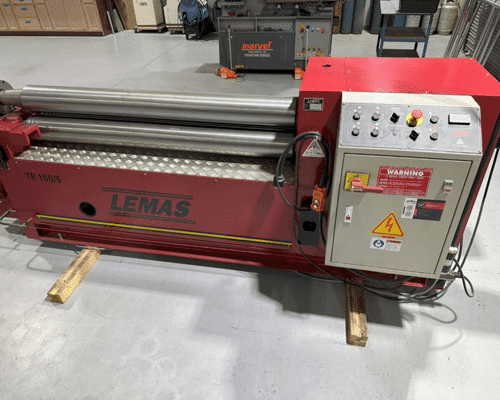
LEMAS Three-Roll Plate Rolling Capabilities
Our NC LEMAS plate roller uses three-roll initial-pinch bending technology to form plate and sheet into controlled curves, cylinders, and conical sections. Hydraulic adjustment of both the rear bending roll and lower pinch roll gives the operator controlled pressure throughout the rolling process.
Capabilities include:
- Three-roll initial-pinch forming
- Hydraulic rear-roll adjustment
- Hydraulic lower-roll adjustment
- Cylinder production
- Conical section forming
- Curved plate and sheet forming
- Custom radius work
- Preparation for welded assemblies
Cylinder, Cone & Curved Component Forming
The LEMAS roller can produce standard cylinders, curved sections, and custom rolled components where consistent radius and smooth forming are required.
The hydraulically tiltable rear roll supports cone rolling for tapered or angled shapes. This makes the equipment useful for transitions, conical sections, ducting, vessel-related components, and other fabricated parts that cannot be produced with simple straight bending alone.
Hydraulic Control & Drop-End Handling
Hydraulic adjustment allows controlled pressure during the forming cycle, helping operators make repeatable corrections as the material is rolled.
The hydraulic drop end allows completed cylinders and cones to be removed from the machine more efficiently, reducing handling difficulty and helping protect the finished shape during unloading.
Materials We Roll
Suitable projects may include:
- Carbon steel
- Stainless steel
- Aluminum
- Other compatible sheet and plate materials
Actual rolling capacity depends on material grade, thickness, width, desired radius, part geometry, and forming requirements.
Benefits of NC Plate Rolling
- Controlled curved forming
- Cylinder and cone capability
- Hydraulic pressure adjustment
- Repeatable forming for custom and production work
- Efficient removal of completed rolled parts
- Custom radius capability
- Integration with welding and downstream fabrication
From Rolled Plate to Finished Assembly
Rolled components often move directly into welding for seam closure, attachment of flanges, supports, or other fabricated features.
Projects can also incorporate CNC bending, cutting, machining, inspection, and finishing through the same fabrication workflow.
See our fabrication machinery for the broader equipment supporting these operations.
Industries We Serve
Our plate rolling capabilities support:
- Industrial manufacturing
- Tanks and vessel-related components
- Ducting and transitions
- Equipment fabrication
- Commercial manufacturing
- Marine fabrication
- Custom metal fabrication
Why Choose Freedom Fabricators for Plate Rolling?
Freedom Fabricators combines NC plate rolling with cutting, bending, welding, machining, inspection, and finishing capabilities. Customers can move from flat plate to a rolled and welded assembly without coordinating multiple unrelated vendors.
This integrated approach helps maintain better control over fit-up, geometry, and downstream fabrication from the original drawing through the finished component. Explore our complete metal fabrication services or contact Freedom Fabricators to discuss your project.
Frequently Asked Questions About NC Plate Rolling
What types of components can Freedom Fabricators roll?
The LEMAS plate roller can form cylinders, conical sections, curved plate, rolled sheet, custom-radius components, and parts that will continue into welded assemblies.
What is a three-roll initial-pinch system?
A three-roll initial-pinch system uses rolls to grip and progressively form the material into the required curve. This arrangement provides controlled bending pressure and supports repeatable curved forming.
Can the LEMAS roller form cones?
Yes. The rear roll is hydraulically tiltable, allowing the machine to form conical sections and tapered components in addition to standard cylinders.
How does hydraulic adjustment help the rolling process?
Hydraulic adjustment of the rear bending roll and lower pinch roll gives the operator controlled pressure throughout the forming cycle, supporting smooth and repeatable rolling.
What does the hydraulic drop end do?
The hydraulic drop end opens the machine so a completed cylinder or cone can be removed more easily after rolling.
Can rolled components be welded afterward?
Yes. Rolled components can continue into welding and other fabrication operations to create completed assemblies.
Need a Cylinder, Cone, or Custom Rolled Component?
Send Freedom Fabricators your drawing, material specification, thickness, width, desired radius, geometry, and quantity. Our team can review the component and determine the appropriate rolling and downstream fabrication process.